A Brief and Incomplete History of Writers’ Inner Voices, Part 3: The Romantics and the Victorians

There’s a very long tradition of writers talking about their characters’ voices. It was, after all, because of that tradition that we ran our study of writers at the Edinburgh Book Festival in the first place. Yet the study is more of a snapshot in time, capturing the similarities and differences between writers at a particular moment rather than across different periods. So in this blog series we’ll take the long view, following the thread as it weaves in and out of history.

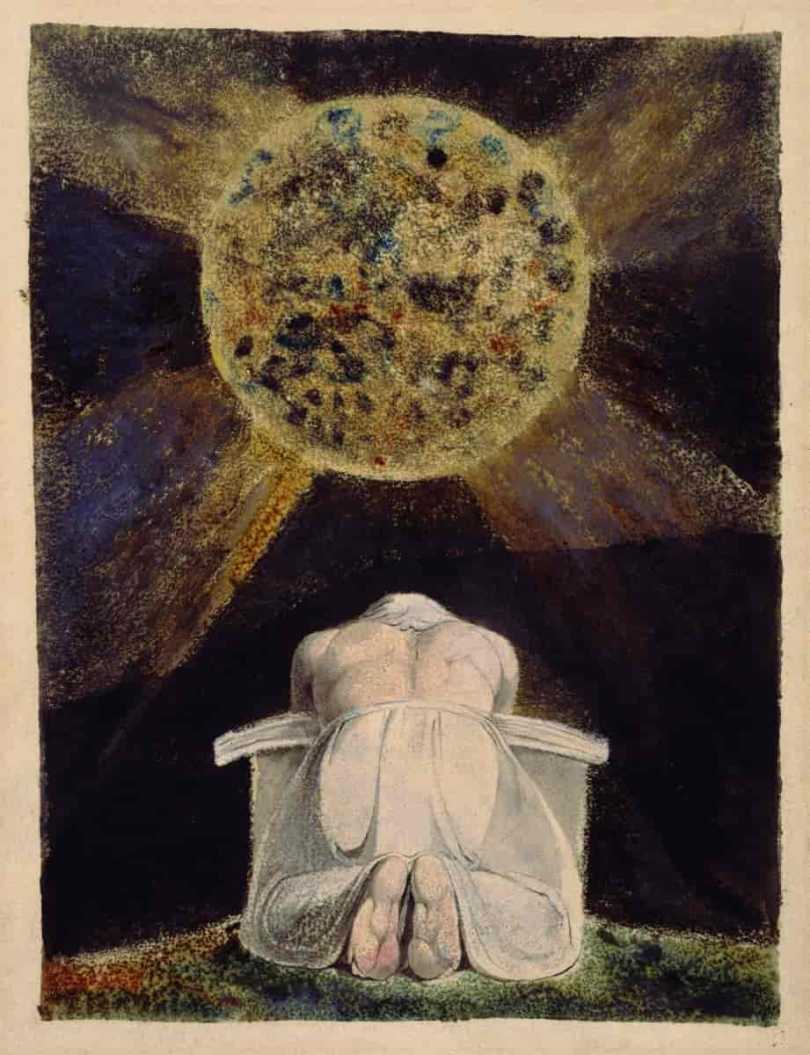
(Blake, Frontispiece to The Song of Los)

In the third instalment of our four part series on the history of writers’ inner voices, John Foxwell writes:

We ended last time with the idea which seems to be at the heart of the creativity debate: that there are two parts of the mind (a ‘controlling’ part and an ‘uncontrolled’ part), and that the production of art involves some kind of interaction between the two. The debate itself is usually around which part is more important, and this in turn is usually related to whatever is considered ‘good’ art at the time.

By and large, the Romantics fall pretty squarely into the ‘uncontrolled’ camp. ‘All good poetry,’ according to William Wordsworth, ‘is the spontaneous overflow of powerful feelings’ – and although he tempers this pronouncement a little by saying that it also requires the poet to have ‘thought long and deeply’ on a subject, he ends up coming full circle by saying that thoughts are ‘representatives of all our past feelings’. Similarly, his famous idea of poetry coming from ‘emotion recollected in tranquillity’ pretty quickly gets rid of the actual tranquillity:

I have said that poetry is the spontaneous overflow of powerful feelings: it takes its origin from emotion recollected in tranquillity: the emotion is contemplated till, by a species of reaction, the tranquillity gradually disappears, and an emotion, kindred to that which was before the subject of contemplation, is gradually produced

(Wordsworth, Preface to the Lyrical Ballads)

From around the same time, and showing a broadly similar strain of thought, we have William Blake’s excuses for failing to follow his brief for a commission:

I find more and more that my style of designing is a species by itself, and in this which I send you have been compell’d by my Genius or Angel to follow where he led […] At any rate, my excuse must be: I could not do otherwise; it was out of my power! […] tho I call them mine, I know they are not mine, being of the same opinion with Milton when he says that the Muse visits his slumbers and awakes and governs his song

(Blake, Letter to Dr Trusler, Aug 1799)

Samuel Coleridge, meanwhile, has his well-known story of the composition of Kubla Khan, which he claimed came to him in a ‘profound sleep’ during which he composed ‘two or three hundred lines’. In Coleridge’s account,

all the images rose up before him as things, with a parallel production of the correspondent expression, without any sensation or consciousness of effort.

(Coleridge, Prefatory Note to Kubla Khan)

There’s a fairly involved debate around just how true this story is, given that there’s some evidence that Coleridge did in fact make changes to both the poem and the story of its composition. What matters for us here, though, is the way that the story of the composition ended up being an essential part of the poem itself. It’s potentially a major part of how the Romantics shift the overall debate around creativity back to something like its original footing, since the process of composition becomes bound up with the ‘value’ the work is thought to have. Just as the idea of Muses etc. implied that the value of a work was already guaranteed by its divine origin, so the idea of the poem arising uncontrolled from the poet came to be associated with ideas like integrity and ‘authenticity’.

At least, that’s how it all looks in hindsight, and taking a very broad view. It’s worth bearing in mind that it seems like the Romantics didn’t really introduce a new idea of what artistic creation involved. As we’ve seen, the general idea that creativity includes a part that’s somehow outside of the individual’s conscious control has such a long tradition that it’s pretty much built into the language. Instead, it’s more that the Romantics created the impression that the uncontrolled, unadulterated impulse was a more certain guide to artistic merit.

In any case, it’s also with the Romantics we begin to start seeing references to the independence of characters, since the period coincides with the growth of the novel. This growth is as much literal as figurative – not only does the form change, but novels just start getting longer and longer, and thus authors start getting preoccupied with their characters for greater stretches of time. Walter Scott, for instance, includes an ‘introductory epistle’ to one of his novels which presents a dialogue between the Author of the Waverley Novels (i.e. himself) and the fictional Captain Clutterbuck, where the Author describes his experience of writing:

I think there is a daemon who seats himself on the feather of my pen when I begin to write, and leads it astray from the purpose. Characters expand under my hand; incidents are multiplied; the story lingers, while the materials increase; my regular mansion turns out a Gothic anomaly, and the work is closed long before I have attained the point I proposed.

(Scott, The Fortunes of Nigel)

As the Author points out, this makes it rather difficult to plan his novels as carefully as he should like – especially since, in his experience, the more he tries to consciously shape a passage, the less the public appears to like it (at least in comparison to those passages which he writes in a hurry). Again, this seems to fit with the overall Romantic preference. Yet perhaps more importantly, Scott also makes it plain that there’s a personal reason for letting his characters dictate the course of his writing: he gets bored if he’s in complete control. If he ‘resists the temptation’ to follow his characters rather than sticking to the plot, his thoughts become ‘prosy, flat, and dull; I write painfully to myself, and under a consciousness of flagging which makes me flag still more.’

With the Victorian novelists, reports of the freedom of characters are even more pronounced. Like Scott, these writers were under a certain amount of pressure to churn out large volumes of prose at speed to meet their publication deadlines (many novels of the period being published in serial instalments). Anthony Trollope, for instance, is famous for writing with his watch beside him and making sure he wrote ‘250 words every quarter of an hour’. Yet Trollope, perhaps even more than Scott, was committed to realising his characters as much as possible. An author, he claimed, must ‘live with’ his characters:

They must be with him as he lies down to sleep, and as he wakes from his dreams. He must learn to hate them and to love them. He must argue with them, quarrel with them, forgive them, and even submit to them. […] On the last day of each month recorded, every person in his novel should be a month older than on the first.

(Trollope, Autobiography)

Even after having killed off one of his characters in a fit of pique – after hearing a couple of men at his club complaining about her turning up too often – Trollope found that she stayed with him.

It was impossible for me not to hear their words, and almost impossible to hear them and be quiet. I got up, and standing between them, I acknowledged myself to be the culprit. ‘As to Mrs. Proudie,’ I said, ‘I will go home and kill her before the week is over.’ And so I did. 

I have sometimes regretted the deed, so great was my delight in writing about Mrs. Proudie, so thorough was my knowledge of all the little shades of her character. […] I have never disserved myself from Mrs. Proudie, and still live much in company with her ghost.

(Trollope, Autobiography)

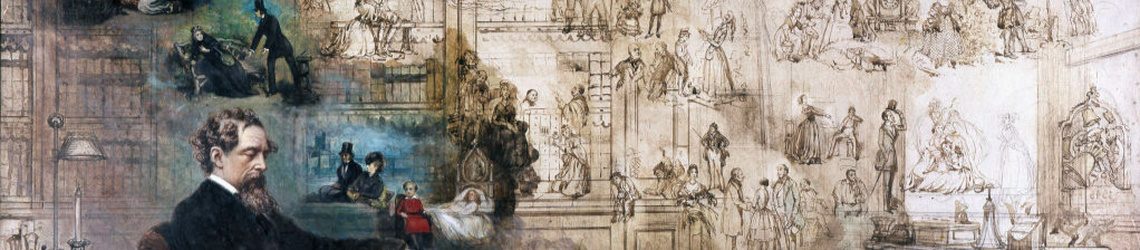
Charles Dickens also frequently described the independence of his characters, with his own experience being more akin to that of an observer than a creator:

I don’t invent it – really do not – but see it, and write it down… It is only when it all fades away and is gone, that I begin to suspect that its momentary relief has cost me something.

(Dickens, Letter to John Forster, Oct 1841)

As to the way in which these characters have opened out, that is, to me, one of the most surprising processes of the mind in this sort of invention. Given what one knows, what one does not know springs up; and I am as absolutely certain of its being true, as I am of the law of gravitation – if such a thing be possible, more so.

(Dickens, Letter to John Forster, Oct 1843)

As with Trollope, Dickens’ characters did not necessarily ‘leave’ when the novels in which they featured were complete. According to the publisher and poet James T. Fields, Dickens told him that

…when the children of his brain had once been launched, free and clear of him, into the world, they would sometimes turn up in the most unexpected manner to look their father in the face.

(Fields, Yesterdays with Authors)

If we were to leave things here, we might be tempted to draw all sorts of connections between the way these writers were working – churning out vast amounts of material for popular consumption in a relatively short amount of time – and the experiences they describe of the independence of their characters. Yet as we shall see, despite the variations in both production and intended audience that start coming in at the turn of the century, the experience of independent characters continues to turn up all over the place. What we can say instead, perhaps, is that over the course of the 19th Century the ‘uncontrolled’ dimension of the creative process remains very much a part of how writing is talked about – it’s just that it begins to crystallise around characters.

For the other posts in the series, see:

Part 1: The Muses and Classical Literature
Part 2: Medieval and Renaissance Writers

Part 4: The Twentieth Century

A Brief and Incomplete History of Writers’ Inner Voices, Part 2: Medieval and Renaissance Writers

In the second instalment of our four part series on the history of writers’ inner voices, John Foxwell writes:

Picking up where we left off, the Muses were beginning to fall out of fashion towards the end of the classical period. At first, it seems that the Muses didn’t so much just get forgotten about, but were actively rejected. In some cases, this was connected with the rise of patronage – the funding of the arts by nobles and wealthy citizens, who wanted a poem’s opening acknowledgements to feature their name instead of a deity’s. As a result, you get classical writers like Persius the Satirist claiming that poets don’t write because of divine inspiration, but because they want to put food on the table.

When we enter the medieval era, these ideas are still going strong. Writing – at least of the kind we’re talking about here – was thought about more as a trade than anything else. Rather than being divinely inspired, it was a craft that could be learned and made use of on demand. That’s how writing was sometimes talked about, anyway; but it would be a mistake to leave things there.

Although the rise of patronage may well have introduced a bit of hard-headed pragmatism into how people conceived of writing, there are several other factors to take into account. To put it bluntly, the medieval era is conceptually messy (or fertile, depending on how you look at it). For one thing, talk about ‘voices’ and ‘inspiration’ was generally reserved for Scripture – and it could be very dangerous to lay claim to any kind of divine communication. It’s not necessarily all that surprising, therefore, that there came to be different accounts of how spiritual and secular writing was produced. On top of that, there was a rather different way of understanding ‘ideas’: where they came from, which ones had merit or value, and what it meant to ‘create’ something new. Originality wasn’t necessarily a good thing – it was much more important to link up to a tradition, to something which had ‘authority’ and pre-established value.

Finally, what we call ‘medieval’ spans such a long period of time, and so many different emerging traditions (even just keeping to Europe), that it’s not really accurate to talk about it as if it has any kind of consistency. Of course, the same is true of the classical period – and in a way, part of what makes the medieval era so varied is that the works different classical authors went in and out of fashion. Virgil was popular in the early middle ages, for instance, but by the 12th century Ovid had rather taken his spot. Platonic ideas (though not Plato’s actual works) were dominant for much of the period, but the 12th-century ‘rediscovery’ of Aristotle changed the intellectual playing field a great deal. Equally, the Renaissance – the ‘rebirth’ of classical thought and aesthetics – could be said to begin at different times in different places in Europe, with authors like Dante and Petrarch getting the ball rolling in Italy a couple of centuries early.

By the time we do get into the Renaissance the Muses are back in fashion, as poets strived to imitate classical authors. However, they’re given a slightly different spin. On the one hand, the ‘Muse’ might be the object of love who inspires the poet to write:

Thus she who among ladies is a sun, moving the rays of her lovely eyes, in me creates thoughts, acts, and words of love…

(Petrarch, Canzoniere 9)

Here we find what is, for us, a familiar part of the modern idea of inspiration: as compulsion, or motive force, something that drives us to do. Again, this idea isn’t necessarily absent from late classical literature, but it’s definitely something that returns in force. It’s also noticeable that ‘inspiration’ is beginning to be divorced from the literal sense of being breathed into, and is now more generally applying to the other senses (in Petrarch’s case, the eyes).

On the other hand, the ‘Muse’ (singular) might refer to the creative impulse as a part of the poet’s own mind. Shakespeare, for instance, frequently rebukes his Muse for being ineffective, idle, or absent (she doesn’t answer back). Sidney, meanwhile, has his Muse rebuking him:

Biting my truant pen, beating myself for spite,

“Fool,” said my Muse to me, “look in thy heart, and write.”

(Sidney, Astrophil and Stella)

However, before too long we also get writers who mock this classical conception of creativity, trying to bring it back to firm, rational ground. The philosopher Thomas Hobbes, for instance, writing about fifty years after Shakespeare, calls the contemporary appeal to the Muses,

a foolish custom, by which a man enabled to speak wisely from the principles of nature, and his own meditation, loves rather to be thought to speak by inspiration, like a bagpipe.

(Hobbes, Answer to the Preface to Gondibert)

Of course, it could be that the appeal to the Muses is just another adornment which the Renaissance and early modern poets borrowed to make their works look ‘classical’. Yet on top of the return of the Muse(s), we also get the return of the notion of the poet not being entirely in control of what’s being produced. Again, as with the classical writers, this is sometimes cashed out in terms of the old creativity/madness trope – and as before, this is more to do with separating artistic creation from ‘rational’ forms of thought than anything else.

More than cool reason ever comprehends.

The lunatic, the lover and the poet

Are of imagination all compact.

(Shakespeare, A Midsummer Night’s Dream)

We find much the same thing in Hobbes, who talks about the need for reason to regulate ‘fancy’ (i.e. imagination) to produce art rather than madness. In fact, this dichotomy between reason and imagination – and the idea that art involves some kind of mediation between the two –  continues to turn up all over the place through the early modern period and the Enlightenment, until it becomes something of a given. The terms change, and the focus changes, but the basic idea is that there’s always this interaction between an uncontrolled bit of the mind (imagination) and a controlling bit of the mind (reason). What varies more significantly is the value placed on either the uncontrolled or the controlling part.

For the other posts in the series, see:

Part 1: The Muses and Classical Literature
Part 3: The Romantics and the Victorians

Part 4: The Twentieth Century

A Brief and Incomplete History of Writers’ Inner Voices, Part 1: The Muses and Classical Literature
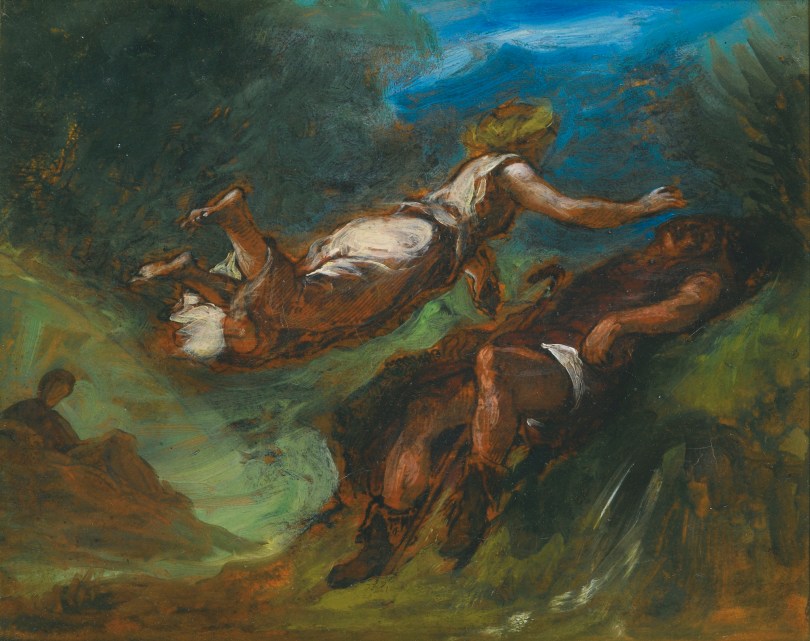
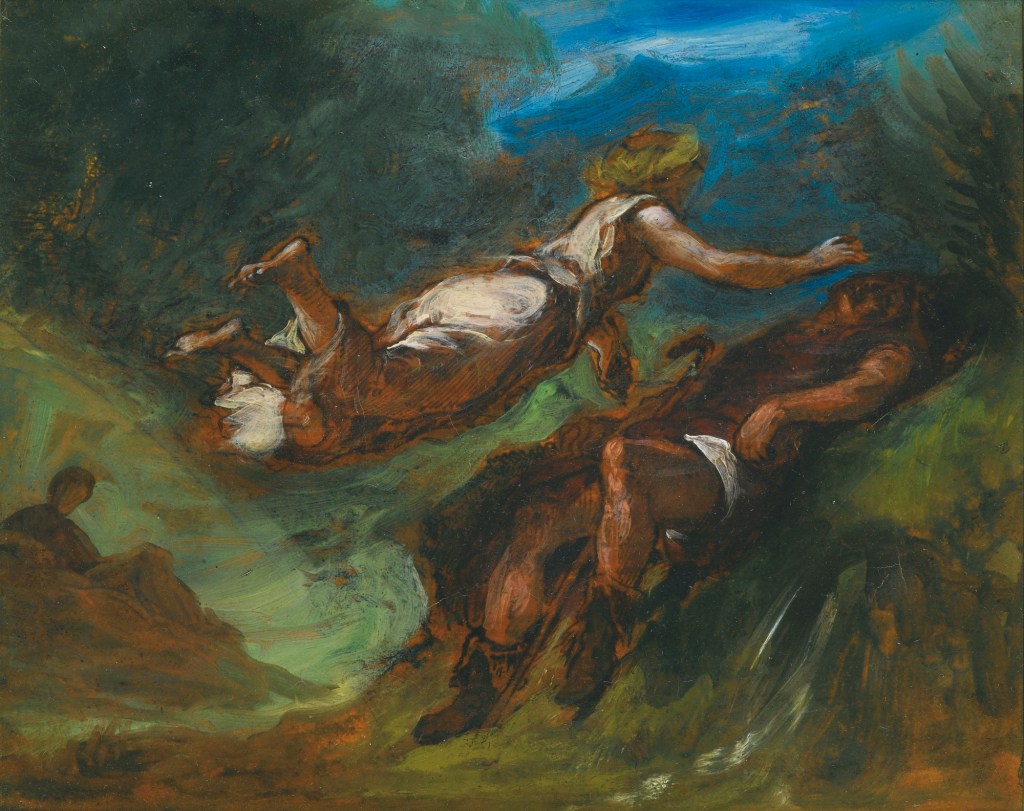
(Eugène Delacroix, Hésiode et la Muse)

In the first of our four part series on the history of writers’ inner voices, John Foxwell writes:

There’s a very long tradition of writers talking about their characters’ voices. It was, after all, because of that tradition that we ran our study of writers at the Edinburgh Book Festival in the first place. Yet the study is more of a snapshot in time, capturing the similarities and differences between writers at a particular moment rather than across different periods. So in this blog series we’ll take the long view, following the thread as it weaves in and out of history.

We start out with the Muses of Ancient Greece, the goddesses of the creative arts. They might not be ‘characters’ in the strict sense, but theirs are the voices which the Classical writers talk about. The way this is sometimes figured is with the writer as a sort of medium, so that the Muse is responsible for the actual business of composition. For instance, both The Iliad and The Odyssey open with a request to the Muse to speak:

Sing, goddess, the wrath of Achilles…


(Homer, The Iliad)

Tell me, Muse, of the many-sided man…


(Homer, The Odyssey)

One of the most detailed accounts of the Muses themselves is provided in Hesiod’s Theogony, where the Muses do actually appear as ‘characters’ within the poem. Rather than beginning by asking the Muses to sing/speak through him in the present, the poet describes meeting them in the past when he was a mere shepherd on the slopes of Mount Helicon. There, the Muses ‘breathed into’ him a wondrous voice and taught him ‘fine singing’, before telling him the history of the gods. The implication seems to be that the Muses may have taught the poet how to sing, and may also have taught him what to sing about, but they have not actually composed this particular song that the poet is singing. (Fairly early on the poet even directly quotes what the Muses said to him on first appearing, which therefore suggests that the rest of the poem is not a direct quotation.)

Plato also has a great deal to say about poets and poetry – often because he’s trying to prove that philosophy is better. For him, poets are ‘possessed’ by the gods, like revellers in a Bacchic frenzy. The main ‘proof’ he uses for this argument comes from the way in which the reciters of poetry are moved emotionally by the fictional scenes they are describing: since they are responding to things that aren’t actually happening in front of them, they are apparently ‘not in their right mind’ and are ‘carried out’ of themselves (Ion). The secondary proof (which he dwells on rather less), comes from the fact that the same poet can write very good and very bad poetry.

Tynnichus the Chalcidian affords a striking instance of what I am saying: he wrote nothing that any one would care to remember but the famous paean which, in every one’s mouth, is one of the finest poems ever written, simply an invention of the Muses, as he himself says. For in this way, the God would seem to indicate to us and not allow us to doubt that these beautiful poems are not human, or the work of man, but divine and the work of God; and that the poets are only the interpreters of the Gods by whom they are severally possessed.

(Plato, Ion)

In a nutshell, the good poem is the work of the Muses, as can be seen by the fact that it is indeed very good, and the bad poem is the work of the writer on his own (in this case, Tynnichus).

The overall point Plato ends up reaching is that poets do not really create anything through any kind of art or talent – at most, their talent is in allowing themselves to become possessed, like a seer or oracle. This in turn allows him to argue that poets don’t really understand the things they’re singing about:

…not by wisdom do poets write poetry, but by a sort of genius and inspiration; they are like diviners or soothsayers who also say many fine things, but do not understand the meaning of them.

(Plato, Apology)

Aristotle, meanwhile, is a bit more circumspect. Having devoted a whole treatise to how poetry/drama actually works (his Poetics), he is rather more inclined to acknowledge that a poet might be consciously and skilfully manipulating their material.

In constructing the plot and working it out with the proper diction, the poet should place the scene, as far as possible, before his eyes. In this way, seeing everything with the utmost vividness, as if he were a spectator of the action, he will discover what is in keeping with it, and be most unlikely to overlook inconsistencies.

(Aristotle, Poetics)

However, Aristotle is still willing to concede that this kind of immersion in the world of the story could be reached by different routes. He therefore suggests that poetry can be either the product of the poet’s own talent or the appropriate kind of possession or ‘madness’, since ‘the former can easily assume the required mood, and the latter may be actually beside himself with emotion’ (Poetics). No Muses are involved here, by the way – for Aristotle, it’s more a question of whether or not the poet is deliberately adopting the relevant mood, or is just being swept up by the contents of his or her own work.

The upshot of all this is that in Classical literature we seem to have a few different ways of understanding the poet’s role in creating the poem. The poet could be a sort of medium for the gods, taking down their words exactly; or, the poet could be translating what the gods have said into verse; or, the poet could merely be making use of a talent which is recognised as being bestowed by the gods.

Yet even though the scaffolding of the Muses was eventually taken away, the basic structure remained – a persistent sense that in order to create poetry, some other force needed to be ‘moving’ the poet. To a certain extent, this idea is rooted in how we still talk about creativity: ‘inspiration’, after all, comes from the Latin inspirare, meaning ‘to blow or breathe into’. We also ‘have’ ideas – we don’t talk about making them, but instead they ‘come to’ us. So the legacy of the Muses is still with us, even though (as we shall see), the force that moved the writer shifted position from being something external to something internal.

For the other posts in the series, see:

Part 2: Medieval and Renaissance Writers

Part 3: The Romantics and the Victorians

Part 4: The Twentieth Century

How do the voices speak?

Crowd of voices

Photo by Anton Kraev

David Napthine writes:-

My colleagues John Foxwell and Angela Woods recently conducted a survey with hundreds of writers (a follow up to one in 2014 at the Edinburgh International Book Festival). Framed within a precise methodology it has elicited fascinating insights into the role of “the voice” in writing. It is well worth reading.

On the other hand my approach is distinguished by a lack of rigorous methodology, its hallmark being a series of bald questions to provoke conversation.

I asked the question “how do the voices speak?” Writers have interpreted this in different ways (which is what I hoped for). For some, like C.H., the first indication that a voice is about to “speak” comes through sensation “like a breeze through my mind, a drift of ideas apparently randomly juxtaposed”. Then “the words jostle to be noticed, compel me to work with them”. In a similar vein R.C. describes “a trickle, an underground stream that disappears for a while before resurfacing” which at other times becomes a torrent to which “I have to surrender myself completely.” and “drown in their torrent”. These voices then become demanding and challenging “random fragments of characters, conversations, ideas, words and phrases.”

For FH “They speak quietly in volume but with an intensity that makes it hard to ignore them. It is a continuous urging.

Uncomfortable though the babble of voices may be they do seem to serve a purpose. They bully the writer to write. It’s almost as if these voices are crying out to be heard by others and they ‘use’ the writer to give them expression. There could be a more prosaic explanation. Writers need to write just as runners need to run and mothers need to mother. Writing is a part of who they are, their identity as people, so there exists a predisposition to be open to as much as possible so that they can be who they are.

Others do not talk of voice. SC:-

“In ‘Robinson Crusoe’ (I adapted this for radio) Defoe describes Crusoe as ignoring or obeying the dictates of his conscience – an inner feeling of rightness. I think my sense of ideas is akin to this notion. Not a voice as such but a feeling.”

This “inner feeling of rightness” finds echo with RH:-

“The sudden surprising thought/ feeling/conviction. I don’t call it a voice as I don’t hear anyone speak. But it has the clarity of a voice. It encourages a particular decision. It feels quite different from the usual more gradual process towards a decision.”

This idea of the “inner sense” that guides, be it conscience, conviction, or feeling, though not an auditory hallucination as such indicates, perhaps, a heightened consciousness that manifests when we are in a state of focused thought (creative or otherwise). The emergence of that feeling or sensation into the realm of interpretation and action has “the clarity of a voice” without it being a vocal presence

EP is very specific as to how the voices speak, distinguishing between poetry and other writing:-

“(the voices speak) like me, if it’s poetry, like a particular character if it’s prose, so depends on the gender and culture of the character. I wrote a novel in poems, many in first person voices of characters living in Byker, so teenage Geordie slang or Scottish nana or a refugee mother with broken English. I heard them all with their accents and vocabulary in my head.”

Here we have character voices, conjured by the imagination of the writer,  speaking clearly within that imaginary or fictional world. KF records the same experience:-

“The writing voices speak inside my head in the voice of a character.”

But as the statement implies she hears other voices and these “are outside me, around two to three feet away and from different positions and more than one voice.”

KF makes a very clear distinction between the two voice-hearing experiences with one being much more pleasant and bearable than the other. The writing voices are heard in, and in the vicinity of, the writing room whereas the others can be heard anywhere. The writing voices stop when KF has finished writing (or soon after) and has left the writing room. I pretend no answer to this but I wonder if the mental state a writer is in (e.g. in “the zone” or preparing to be in “the zone”) creates a framework of expectation that lets the voices speak.

For CP the experience of a voice speaking was vivid:-

“I saw the character in my house following me around as I did things, such as make myself coffee or check email. He spoke using the same voice as he does in the story, but unlike normally he addressed me directly. He speaks with a cultured accent, very much one of an Oxford Professor type. Measured, calm, which made it all the more shocking when he became irate, which didn’t happen until I said I wasn’t understanding some of his points. My characters don’t normally leave the story world, and he was in my world. It wasn’t frightening, but it was unsettling. I knew something different was happening and I had no idea why.”

This voice is very specific in its speaking. A product of the writer’s imagination, the character is so strong that it can step out of the storyworld and act in this world (1). The writer goes on to say that his conversation with the character began:-

After he held up a copy of the manuscript and said “We need to talk about this.” I felt it was my entering the room, as if it was my arrival that triggered the beginning of the conversation.

It is interesting to note that here the writer is still the initiator of the conversation and that it was triggered by a physical action. This phenomenon of the character stepping out of the storyworld is the subject of a significant study by project members (2).

As a counterpoint to all of the above I will leave you the words of BK:-

I don’t “hear” voices in my head.  I can just do dialogue in different voices.  I don’t know why.

 “I don’t know why” is perhaps an appropriate ending for this post

Notes

  1. Relationship of writer to character is explored in future post
  1. See for example “Uncharted features and dynamics of reading: Voices, characters, and crossing of experiences” by Ben Alderson-Day, Marco Bernini, Charles Fernyhough in https://www.journals.elsevier.com/consciousness-and-cognition

On Inspiration

David Napthine writes:

WRITING SOMETHING

On being asked to oversee the “Writers’ Inner Voices” blog I thought I should write the first post. The thing is, I’ve no idea how to start and I’ve no idea what to say. And I’m not sure I quite understand what it is I’m writing about. However, as a friend pointed out I’ve made a living writing about things I don’t understand for years so why worry about it now.

A Script Editor once said to me “don’t get it right, get it written”. So here goes. Over the last few months I’ve been talking to writers, running (with John Foxwell) writers’ workshops, and spoken with others in Hearing the Voice about “hearing voices” in all their manifestations.

Well now I’ve written something I’m stuck as to what to write next. So I’ll make a cup of tea, sort paperclips according to size and colour, check the Welsh team selection for the second test against Argentina and then have another go.

WRITING SOMETHING MORE

Well I’m back now and I’m ready to start. (Wales have selected two open-side flankers. There’s bold.)

In this blog, new posts will appear at different times, be of different lengths, and cover a multitude of thoughts and ideas about the Writers’ Inner Voices project. I’ll tell you about writers’ thoughts and experiences, what’s come out of the workshops, what has emerged from gatherings, lectures, conferences, seminars, and the pub.

I’m hoping these will prompt posts from writers of all types and inclination, clinicians, academics, students, members of the public passing through on their way to Scarborough, Albanian copywriters etc. I’d like a blog that is informative, contradictory, disputatious, supportive, elegant, discursive, witty, profound, heartfelt, precise, rambling, coherent, repetitive, discursive, profound, precise and whimsical. For this I need contributions, otherwise it’s just me posting and I’ll bore you before I bore myself so, please, have pity on us all.

RIGHT

HERE GOES

THE FIRST POST

ON INSPIRATION

A question writers are frequently asked is; “where do you get your ideas from?” If you tell them that you get them from other people, overheard conversations, newspapers etc. you can sense their disappointment. What about Inspiration or The Poetic Muse?

A colleague, Peter Garratt, in an article for The Guardian, observed that there is a long-held view that “creativity ignites by admitting some mysterious other voice into the writer’s flow of being”*. From this we can infer that writers wait for Inspiration to visit (hence the question “why don’t writers stare out of the window in the morning?” and the answer “because then they’d have nothing to do in the afternoon”) or they create the circumstances for Inspiration to arrive (long walks, displacement activity, drugs). This idea of Inspiration sounds liberating – let the “mysterious other voice” speak and then follow where it leads.

But what if you wait for Inspiration and it doesn’t come? Does its absence then imprison the writer in stasis, inactivity and frustration? So what can the writer do?

I waited for Inspiration to begin this. None came. No voice, no spark. But I had to write something. I’d promised. So I put words on paper, shuffled them about, crossed them out, shuffled them again, in hope that something would emerge that can be used. It’s like drawing teeth; not pretty and very unpleasant. I’ve fulfilled a promise as best I can. You can’t always wait for Inspiration, there’s not enough time and you won’t get paid.

Why is Inspiration absent? Why can’t “the voice” be heard or the story play out in your mind’s eye? Maybe Inspiration is just being considerate and keeps away because you’ve got to get the kids to school, organise a plumber, go food shopping, and all the other stuff we call life.

Is Inspiration a useful concept? Does it help or hinder? Can I, should I, only write when I hear the voice or feel the spark? If so Inspiration, too pure to live in the everyday, far from being a liberating friend is a cruel acquaintance.  Write because you want to, write because you have to, and write when you can, and don’t wait, lost and lovelorn, for Inspiration. Our creativity should not depend on the whim of a mysterious other voice.

*Peter Garratt. “Hearing voices allowed Charles Dicken to create extraordinary fictional worlds” Article in The Guardian, 22 August 2014.